
Dealing with commercial door problems as an owner or manager of a commercial building can get really old. That’s because commercial doors are quite literally holding up your entire building.
Between building codes, fire codes, ADA requirements, insurance considerations, security needs, and occupancy type regulations, there’s just so much on your plate. If you mess any of this up, you’re looking at failed inspections, citations, liability issues, or worse doors that simply fail to do their job.
We’ve taken it upon ourselves to set the record straight and tell you everything you need to know about commercial doors in NYC.
The Main Types of Commercial Doors
Steel Doors
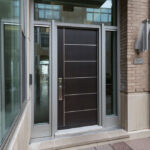
Steel doors are what you’d consider the backbone of commercial doors. You’ll spot them commonly used in stairwells, back entrances, utility rooms and even secondary exits. They’re available in varying thicknesses, and the thicker the gauge, the more secure and durable your door.
A few major advantages of these doors are that they’re extremely durable, fire-resistant, secure, relatively affordable and incredibly low maintenance.
Some key features include:
- Steel doors are available in fire-rated versions
- They can be insulated
- They handle high-traffic
- They’re compatible with most commercial hardware
Aluminum Storefront Doors
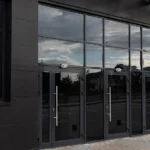
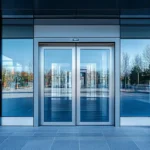
These are glass doors in aluminum frames, the kind you see at retail stores, office building lobbies, and commercial entrances where visibility and natural light are important factors. They offer clean, modern looks and are great for customer-facing businesses.
Some major advantages of aluminum storefront doors include:
- They’re available with tempered or laminated glass for safety
- They can be integrated with automatic door operators
- Aluminum storefront doors come with various frame finishes
Glass Doors
Glass doors generally feature minimal hardware and create a high-end look. They’re perfect for corporate offices, upscale retail, and modern commercial buildings. Glass doors are generally made from thick tempered glass, with thickness varying from 3/8″ to 1/2″. You can incorporate access control and automatic operators on these and choose between clear, frosted or tinted glass.
Fire-Rated Doors
While fire-rated doors aren’t exactly a type on their own, they deserve a separate section. Fire-rated doors can be hollow metal, wood, or glass with special fire-resistant properties. What makes them different is that they’re specifically tested and labeled for fire resistance.
These are ideal for fire exits, stairwells, corridors separating different occupancies, openings in fire-rated walls. These doors contain the spread of flames and smoke, giving people time to evacuate and firefighters time to respond.
Important features of these doors include:
- Labeled with fire rating, such as 20-min, 45-min, and so on
- Are typically self-closing
- Usually self-latch
Also Read: Is Your Commercial Door Up to Code? A Compliance Checklist
What Building Codes Do You Absolutely Need to Abide By?
New York City adopts the International Building Code (IBC) with local amendments. If you’re dealing with commercial door installation in NYC, these codes are legal requirements.
Panic Hardware Requirements
Panic hardware is required for doors serving:
- Assembly (Group A) occupancies with 50+ occupants
- Educational (Group E) occupancies with 50+ occupants
- High Hazard occupancies, regardless of occupant load
- Any door in a Group A or E occupancy
The door must have panic bars that allow the door to be opened by pushing on a horizontal bar.
Installation Requirements
- Mounted 34-48 inches above the floor
- Must be at least half the width of the door
- Must release with 15 pounds of force or less
- Cannot require tight grasping, twisting, or pinching
Fire Door Requirements
If a door is in a fire-rated opening, the door, frame, and hardware must meet specific requirements:
- Must be self-closing
- Must be self-latching
- Must have proper clearances
- Must have fire-rated hardware
- Must be inspected annually
ADA Accessibility
The Americans with Disabilities Act sets requirements for door accessibility:
- The minimum clear width is 32 inches when the door is open 90 degrees
- The opening force must be a maximum of 5 pounds for interior doors, 8.5 pounds for exterior doors
- Must have lever handles or push-type hardware
- There must be a proper clearance on both sides of the door for wheelchair access
Security Features To Keep in Mind
As a building owner or manager, you already know that security in commercial doors is always layered. No single feature makes a door secure. In fact, there are several elements working together to protect the occupants.
1. Access Control Integration
Commercial security rarely relies on physical keys. Access control systems use key cards, fobs, keypads, or biometric readers to control who enters and track when.
These require:
- Electric strikes allow the door to be unlocked electronically
- Magnetic locks hold the door shut with hundreds of pounds of force
- Electric latch retraction involved motors that retract the latch when access is granted
- Integration with building systems, since access control often connects to fire alarms, security cameras, intrusion alarms, and building automation systems
2. High-Security Cylinders and Locks
Standard commercial locks are easy to pick or bump. High-security options include:
- Restricted keyways
- Drill resistance
- Pick resistance
- Bump resistance
3. Reinforced Frames and Strike Plates
A strong door with a weak frame is pointless. Commercial-grade frames should be:
- 16-gauge steel minimum
- Anchored to a structural wall with anchors
- Reinforced at the strike plate location
- Weld on the hinge side for added strength
Your Doorway to Better Compliance
If you need commercial doors in NYC or commercial door installation that meets codes, passes inspections, and secures your building, Door Master New York handles commercial door projects from specifications to installation.
NYC relies on us to provide doors that meet strict fire codes and security measures. We work with all commercial door types and provide all the documentation you need for inspections and insurance.
Get in touch with us today. Security doesn’t wait around for you to be prepared!